

Sequential Function Chart (SFC)
An SFC program is a .sfc file: an ST POU whose body is an SFC … END_SFC
block written with IEC 61131-3’s own keywords, INITIAL_STEP, STEP,
TRANSITION, and ACTION. The text is the program, and the VS Code
extension projects it into the classic chart view where every gesture is a
structural edit to that text.
When to use it
Section titled “When to use it”Reach for SFC when the process has phases: batch sequences, startup and shutdown, state machines that would otherwise be a pile of latches. A step is a state, a transition is the condition that ends it, and actions drive outputs while a step is active, so the chart reads as the sequence of operations the process engineer wrote down. Continuous control belongs in FBD, interlocks in ladder, and algorithms in ST.
A chart, in text
Section titled “A chart, in text”examples/tank-batch-sfc/program.sfc, trimmed of commentary. It fills a
tank, heats and mixes concurrently, drains, and counts the batch, with an
abort path off Fill.
PROGRAM TankBatchVAR_EXTERNAL    Level : REAL; TempC : REAL; Start : BOOL; Abort : BOOL;    FillSP : REAL; EmptySP : REAL; HeatSP : REAL;    FillValve : BOOL; DrainValve : BOOL; Heater : BOOL; Mixer : BOOL;    RunLamp : BOOL; AbortLamp : BOOL; BatchCount : INT;END_VARVAR    mixT : TON;END_VARSFC
  INITIAL_STEP Idle:    N  RunLamp;    R  AbortLamp;              (* clear the latch on return to Idle *)  END_STEP
  STEP Fill:    N  RunLamp;    N  FillValve;  END_STEP
  STEP Heat:    N  RunLamp;    N  HeatCtrl;               (* ACTION block, below *)  END_STEP
  STEP Mix:    N  RunLamp;    N  Stir;  END_STEP
  STEP Drain:    N   RunLamp;    N   DrainValve;    P1  CountBatch;            (* body runs once, on activation *)  END_STEP
  STEP Aborted:    S  AbortLamp;              (* latched until Idle resets it *)  END_STEP
  TRANSITION t_start FROM Idle TO Fill := Start AND NOT Abort;  END_TRANSITION
  (* alternative divergence: abort is declared first, so it has priority *)  TRANSITION t_abort FROM Fill TO Aborted := Abort;  END_TRANSITION  TRANSITION t_full FROM Fill TO (Heat, Mix) := Level >= FillSP;  END_TRANSITION
  (* simultaneous convergence: both sources must be active *)  TRANSITION t_done FROM (Heat, Mix) TO Drain := (TempC >= HeatSP) AND mixT.Q;  END_TRANSITION
  TRANSITION t_empty  FROM Drain   TO Idle := Level <= EmptySP;  END_TRANSITION  TRANSITION t_resume FROM Aborted TO Idle := NOT Abort;  END_TRANSITION
  ACTION HeatCtrl:    Heater := Heat.X AND (TempC < HeatSP);  END_ACTION
  ACTION Stir:    Mixer := Mix.X;    mixT(IN := Mix.X, PT := T#3S);  END_ACTION
  ACTION CountBatch:    BatchCount := BatchCount + 1;  END_ACTION
END_SFCEND_PROGRAM| Element | Form | Notes |
|---|---|---|
| Initial step | INITIAL_STEP Idle: … END_STEP | Exactly one per chart; active on the first scan |
| Step | STEP Fill: … END_STEP | Owns a retained BOOL, Fill.X, and a Fill.T elapsed time |
| Transition | TRANSITION [name] FROM a TO b := <ST expr>; END_TRANSITION | FROM/TO take one step or a parenthesised list; the name is optional |
| Action block | ACTION Stir: <ST statements> END_ACTION | The body is Structured Text |
| Association | N FillValve; | A qualifier plus either an ACTION name or a declared BOOL variable |
How a chart executes
Section titled “How a chart executes”Each step owns a retained BOOL slot, and the initial step’s is declared
:= TRUE, so a cold start finds exactly one step active. Every scan runs one
fixed-order pass: evaluate each transition against the pre-scan activity
snapshot, resolve which ones fire, clear the sources, set the targets, update
step timers, compute actions. Clears run before sets, so a self-loop
FROM S TO S leaves S active. Every transition reads the same snapshot, so
a token advances at most one step per scan, though several transitions can
fire in one scan when several tokens are live.
A transition is enabled when all of its FROM steps are active and its
condition is true. That one rule covers both branch forms:
- Alternative divergence is two or more transitions sharing a source step. Priority is declaration order, first highest, and a lower branch is suppressed only when a higher one sharing a source is itself enabled, so a convergence waiting on an inactive source cannot deadlock the branch below.
- Simultaneous divergence is
TO (Heat, Mix): one transition sets both targets and the token splits. Simultaneous convergence isFROM (Heat, Mix), enabled only when both sources are active.
Qualifiers that compile today are N, S, R, P1, P, and P0. N is
active exactly while the step is. S latches the target on the step’s rising
edge and R clears it, which is the abort/reset pattern above. P1 and P
fire once on the rising edge, P0 once on the falling edge. Associations
targeting the same BOOL variable are OR-combined, so RunLamp drops to
FALSE once no step drives it.
Action bodies are ST, and only ST. A body driven by a level qualifier runs
one extra scan on the falling edge of its active signal, so a body written
against step activity shuts its outputs down: on that final scan
Mixer := Mix.X writes FALSE and mixT(IN := Mix.X, …) resets, clean for
re-entry. A P1 body has no final scan.
Step.T compiles to a hidden TON, and only for steps whose .T is read.
Both .X and .T are legal in conditions and action bodies.
Structural checks
Section titled “Structural checks”nautilus check runs the chart-shape checks before the ST hop;
nautilus sfc check <file> runs them alone.
Errors: duplicate step, action, or transition names; no INITIAL_STEP, or
more than one; a FROM/TO naming a step that does not exist; an empty
condition; a non-initial step that no transition targets (unreachable); an
association naming neither an ACTION block nor a declared variable; a
.X/.T reference to an unknown step; an unsupported qualifier.
Warnings: a dead-end step that no transition sources, which a terminal step may be on purpose; a simultaneous convergence whose sources are not reachable from a common simultaneous divergence; an alternative priority group whose shared-source overlap is not transitive.
The chart then transpiles to ST and compiles like any other program, the line
map putting a type error in a condition on its TRANSITION line and one in a
body on its ACTION line.
In the editor
Section titled “In the editor”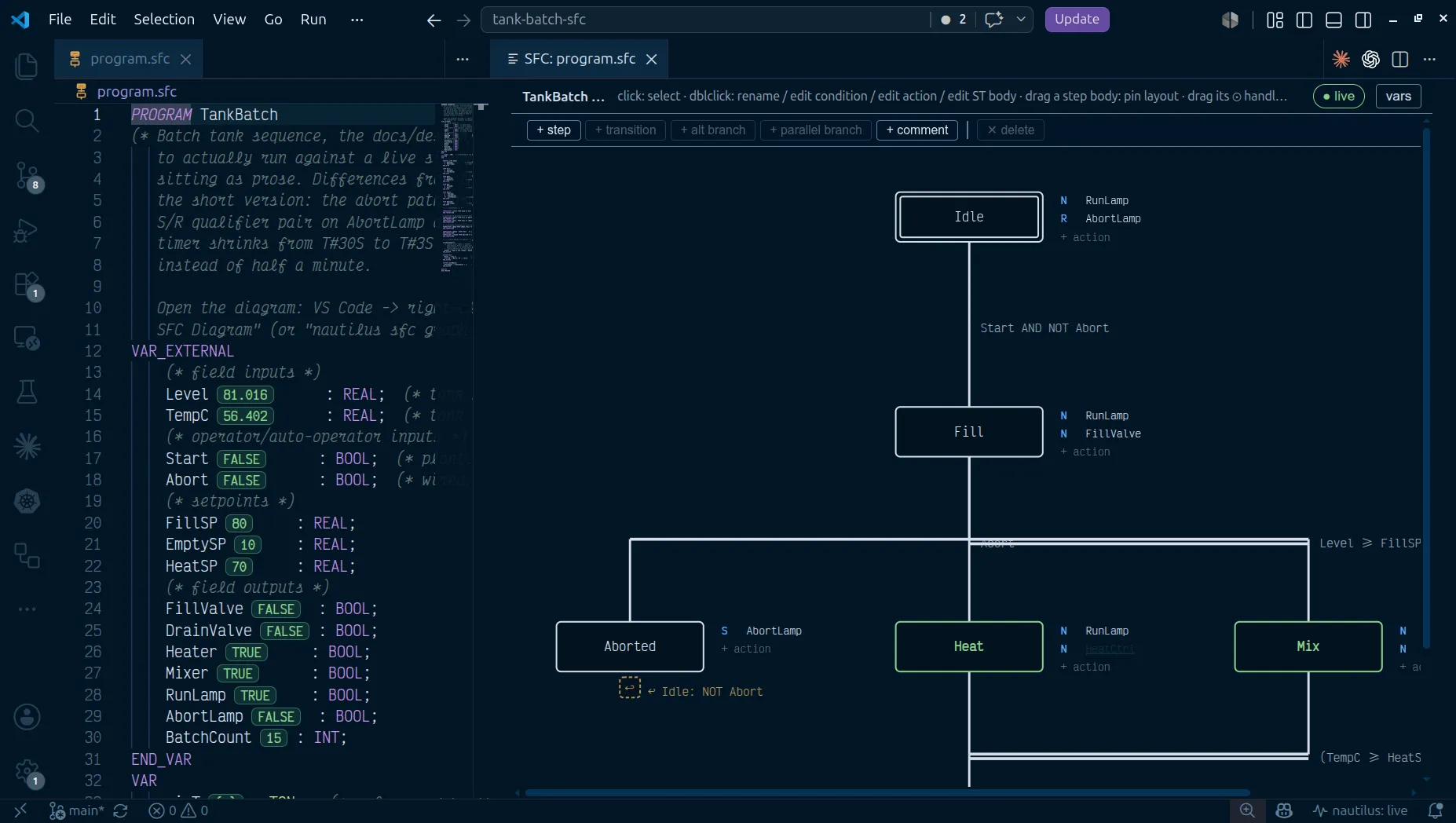
Right-click a .sfc file and pick Open With → SFC Diagram, or run
nautilus: Open SFC Diagram Preview beside the text. Steps draw as boxes,
double-bordered for the initial step, with their associations tabled
alongside. Transitions draw as bars across the flow line, single for a normal
or alternative transition and double for a simultaneous one; a transition
back up the chart becomes a compact ↩ jump glyph. Layout follows the
chart’s topology; drag a step to pin it, and “auto layout” clears every pin.
Every gesture is a structural op resolved in Go into minimal text edits: add
a step or transition, branch an alternative or simultaneous path off one,
drag a step’s connect handle onto another step to wire a transition, edit a
condition, step name, association, or ACTION body in place. A transition
whose FROM or TO no longer resolves stays on the canvas as a red chip
with a retarget popover, and diagnostics show as you type without blocking a
save. With a controller reachable, the active step outlines and its name
highlights, read from the retained step slot exposed in /api/state.
nautilus: Diff SFC Diagram (vs git HEAD) and (vs Controller) overlay added, removed, and changed elements on the chart.
Tooling
Section titled “Tooling”nautilus new --language sfc scaffolds a project with a starter chart.
nautilus check gates it in CI, and nautilus test runs the same
*_test.yaml acceptance tests every other language uses, in virtual time.
nautilus sfc graph <file> emits the render model as JSON, each transition
carrying its derived kind (normal/alt/simDiverge/simConverge), and
nautilus sfc edit applies one structural op to source read on stdin.
Step activity, stored flags, pulse edge memories, and step timers are all
retained VAR slots, so an online edit preserves the
live token and every timer, and a running batch does not restart. Renaming a
step is the exception: the renamed step’s slot is a new name, so its token
resets, listed in the swap report the way an FB-instance rename is.
Pull Program from Controller and nautilus pull bring a field edit back
into the .sfc file for review in git diff.
Not supported
Section titled “Not supported”- The timed qualifiers
L,D,SD,DS,SL. They parse and are reported as an error naming the supported set. - Macro steps and charts nested inside a step. Charts are flat.
- Explicit numeric transition priorities; priority is declaration order.
- Instruction List action bodies. Action bodies are ST.
- Transition indicator variables, and the full standard action-control block.
- Import of vendor SFC (Rockwell
.L5Xroutines, Siemens GRAPH, CODESYS). - Machine-checked token conservation for pathological branch topologies. The structural checks cover the detectable cases.