

Ladder Diagram (LD)
IEC 61131-3 defines ladder graphically. nautilus defines it as text: a .ld
file holds rungs written left to right along the power rail, in a grammar
with the standard’s semantics and no vendor dialect. The VS Code extension
projects that text into a ladder editor where every gesture writes back to
the same file.
When to use it
Section titled “When to use it”Ladder fits boolean logic that gets reviewed by asking which contacts passed
power: interlocks, permissives, latches, motor seal-ins, annunciators and
alarm horns. It is the language most control engineers read fastest, and one
rung is one line of git diff.
Loops and signal conditioning read better as Function Block Diagram. Math, arrays, and plant physics belong in Structured Text. Mix them per task against one tag store.
A rung, in text
Section titled “A rung, in text”interlocks.ld from the heated-tank example, the annunciator running as its
own 200 ms task:
PROGRAM InterlocksVAR_EXTERNAL    TempLowAlm : BOOL;    TempC      : REAL;    HornAck    : BOOL;    Horn       : BOOL;    HiTempAlm  : BOOL;END_VARVAR    HiSecs : TIME; (* how long we've been hot — captured via ET => *)END_VARLD  RUNG hitemp (* comparison as a contact, 5 s on-delay; ET captured with the standard's => output binding *)    GT(TempC, 90.0) t2:TON(PT := T#5S, ET => HiSecs) ( HiTempAlm )
  // Comment runs like this render as notes in the ladder diagram —  // dblclick to edit them there.  RUNG horn (* either alarm sounds the horn until the operator acks *)    [ TempLowAlm | HiTempAlm ] /HornAck ( Horn )
  RUNG ackclear (* the ack releases itself once both alarms clear *)    /TempLowAlm /HiTempAlm ( R HornAck )END_LDEND_PROGRAM
Every element the grammar accepts:
| Element | Text | What it does |
|---|---|---|
| NO contact | Tag | passes power when Tag is TRUE |
| NC contact | /Tag | passes power when Tag is FALSE |
| Rising-edge contact | +Tag | one scan of power on Tag’s 0→1 transition (an implicit R_TRIG) |
| Falling-edge contact | -Tag | one scan of power on Tag’s 1→0 transition (an implicit F_TRIG) |
| Parallel branch | [ a | b ] | OR of its legs; each leg is a series, and branches nest |
| Function contact | GT(TempC, 90.0) | passes power when the call returns TRUE |
| Negated function contact | /GT(TempC, 90.0) | passes power when the call returns FALSE; / negates any BOOL term, /t1.Q included |
| Block in the rung | t2:TON(PT := T#5S) | power drives its power-in pin, and continues from its power-out pin |
| Output capture | ET => HiSecs | binds a non-BOOL output pin to a variable, inside the block’s parentheses |
| Output coil | ( Tag ) | Tag := the rung condition, every scan |
| Set coil | ( S Tag ) | latch: Tag := Tag OR condition |
| Reset coil | ( R Tag ) | unlatch: Tag := Tag AND NOT condition |
| Rising-edge coil | ( P Tag ) | Tag is TRUE for one scan when the rung condition rises |
| Falling-edge coil | ( N Tag ) | Tag is TRUE for one scan when the rung condition falls |
Contacts and coils take the same accessor references FBD takes, so array
elements and struct members address directly: Levels[2], PIT_001.VALUE.
A rung header carries a (* … *) comment; full-line // comments inside
the block are diagram notes.
How a rung evaluates
Section titled “How a rung evaluates”Series elements AND together and branch legs OR, so
[ Start | Run ] /Stop ( Run ) compiles to
Run := AND(OR(Start, Run), NOT Stop). That is the seal-in: Start energizes
Run, Run’s own contact holds it in, Stop drops it out.
Coils sit at the right end of a rung. A rung needs at least one coil or a
function block as its last element: A B t1:TON(PT := T#5S) is a complete
rung whose only output is t1.Q, read elsewhere. Several coils share one
condition, evaluated once and fanned out. A rung with only a coil is driven
by the rail, so ( AlwaysOn ) assigns TRUE. Rungs evaluate
top to bottom within a scan, so a coil written on one rung reads back as a
contact on the next rung in the same scan.
Power is boolean, so anything gating it has to return BOOL. The six
comparisons do. Numeric functions do not, and ADD(TempC, 0.0) as a contact
is a compile error rather than a pass-through; numeric work goes inside a
comparison’s arguments, as GE(ADD(Base, Bias), Limit).
When a block sits in a rung, power drives one input pin and leaves from one
output pin; every other pin is named in the parentheses. TON, TOF and
TP use IN and Q, CTU uses CU, CTD uses CD, R_TRIG and
F_TRIG use CLK, SR uses S1/Q1, RS uses S/Q1. Passing the
power pin yourself (t1:TON(IN := x)) is an error, because power owns it.
Coils assign BOOL only. To store a timer’s elapsed time or a counter’s
value, use the standard’s output binding at the call site, ET => HiSecs
above. Any instance output is also readable as inst.Pin anywhere,
including as a contact: GE(t2.ET, T#2S).
Edge contacts and edge coils are unnamed in the text. The compiler derives a stable instance name from the rung name, the tag, and the position among repeats in that rung, so the edge’s retained state survives an unrelated edit elsewhere in the program.
Types, functions, and blocks
Section titled “Types, functions, and blocks”LD transpiles in one hop to the FBD netlist, which transpiles to ST. Ladder
inherits the whole chain rather than reimplementing it: the built-in
operator, function and function-block vocabulary, user FUNCTIONs and
FUNCTION_BLOCKs from library .st files, arrays and structs through
accessor references, and typed diagnostics mapped back to the rung.
A user block drops into a rung the way a TON does. Power lands on EN if
the block declares one, otherwise on the first BOOL VAR_INPUT the call
does not bind by name, and continues from ENO or the first BOOL
VAR_OUTPUT. Every other pin is bound in the parentheses, with =>
capturing outputs. Instance state persists across scans, and an online edit
carries it by name and type.
Blocks can be written in ladder, too. A .ld file may hold
FUNCTION_BLOCKs whose bodies are rungs, and a .ld file with no
PROGRAM is a project library, the same rule that makes a PROGRAM-less
.st one:
FUNCTION_BLOCK PumpSeqVAR_INPUT Start : BOOL; Stop : BOOL; Level : REAL; StopLevel : REAL; END_VARVAR_OUTPUT Run : BOOL; Warm : BOOL; END_VARVAR t1 : TON; END_VARLD RUNG seal [ Start | Run ] /Stop /GE(Level, StopLevel) ( Run ) RUNG warm Run t1:TON(PT := T#5S) ( Warm )END_LDEND_FUNCTION_BLOCKThis is what ladder has instead of a JSR: a subroutine with pins rather
than shared tags, and retained state per instance. Two pumps are two
instances of one block, each with its own seal-in and its own t1. The
VAR_* sections are ordinary POU declarations, VAR_IN_OUT included, so
a ladder block can take a UDT by reference. examples/ladder-subroutines
is the whole feature in four files. See Function blocks, libraries, and
tasks.
In the editor
Section titled “In the editor”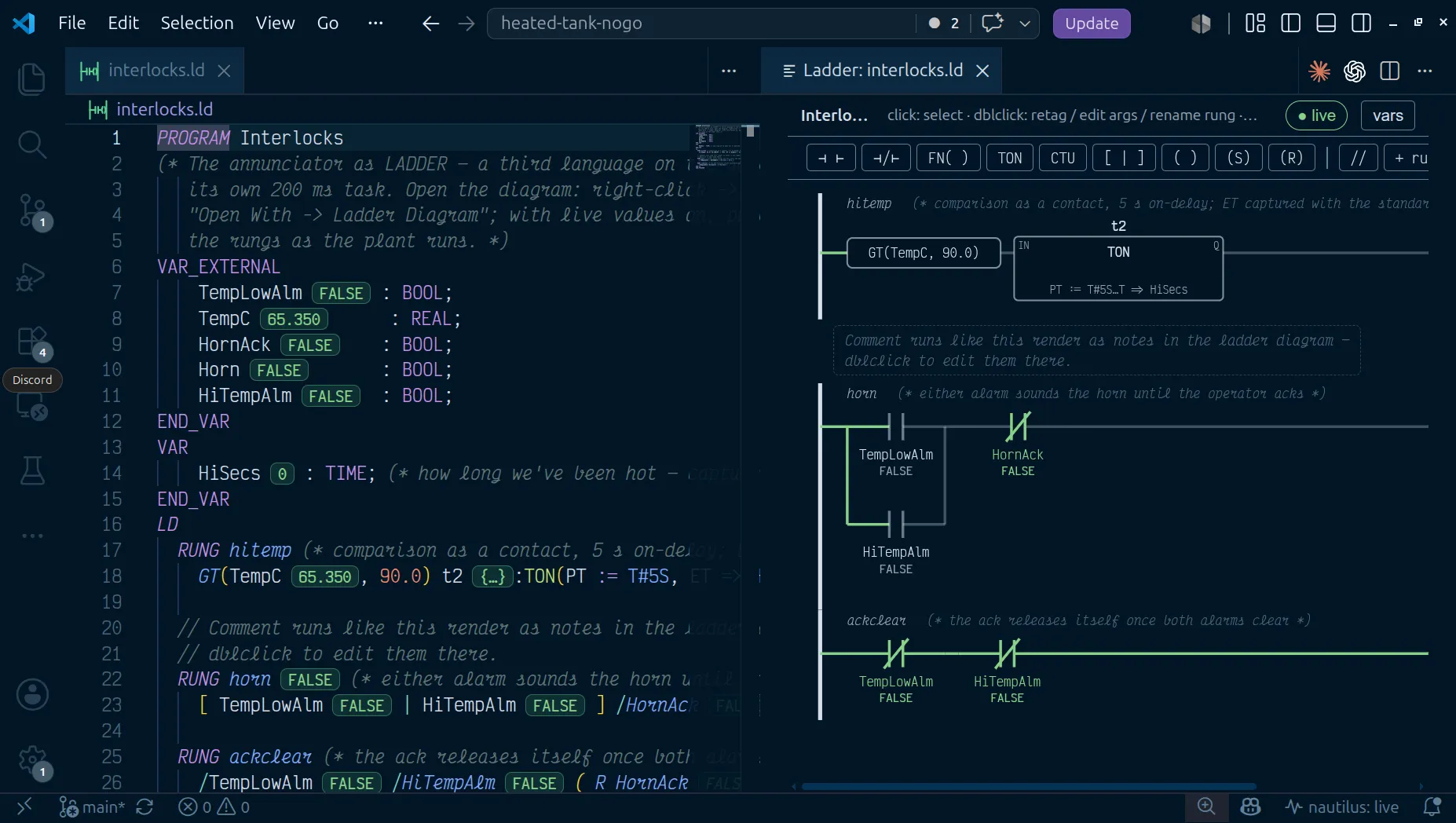
Right-click a .ld file and choose Open With → Ladder Diagram to use
the diagram as the editor, or run nautilus: Open Ladder Diagram Preview
for text on the left and rungs on the right. Layout is canonical, computed
from the source, so no coordinates land in your diffs. Editing gestures
resolve through the Go compiler into minimal text edits:
- A palette of NO contact, NC contact, function contact, TON, CTU, parallel branch, and output/set/reset coil. Click to append at the selection, or drag onto a rung.
- Double-click a contact or coil to retag it, a function contact to rewrite
the call, a block to edit its arguments, the rung name to rename it, and
the
(* … *)slot to write a rung comment. Nflips a contact between NO and NC,Mcycles a coil through output, set and reset,Bwraps the selection in a parallel branch,Deldeletes, and Ctrl+X/C/V cut, copy and paste. A pasted block instance gets a fresh name.- Drag an element to reorder it or move it to another rung. A contact dropped in the coil zone is refused, and so is a coil dropped mid-series.
+ rungadds a rung,//adds a comment note, and the variables panel declares or removes a declaration without leaving the diagram.
With a controller reachable, live values paint power flow: contacts and coils show their state, the wires show whether power reaches that far, and comparisons evaluate locally. An in-rung block reads its real output pin from the controller. Anything unresolvable renders neutral.
nautilus: Diff Ladder Diagram (vs git HEAD) and (vs Controller) overlay the committed or running rungs on the working ones, marking added, changed and removed elements in cyan, amber and red. Green already means power here.
Tooling
Section titled “Tooling”nautilus check # compile every .st/.fbd/.ld/.sfc; errors land on the rungnautilus test # acceptance tests, on the virtual clocknautilus ld graph interlocks.ld # the ladder render model as JSONnautilus ld edit # apply one structural edit op, from JSON on stdinnautilus check composes the line maps back through both hops, so a type
error in the ST a rung produced reports at that rung’s RUNG line. The
language server does the same live.
Online edits treat .ld as the program source. Download, diff against the
controller, and nautilus pull all move the ladder text itself, so the
program a controller reports compares 1:1 with the file in git. See Online
edits.
A rung change reviews as a rung:
RUNG horn (* either alarm sounds the horn until the operator acks *) [ TempLowAlm | HiTempAlm ] /HornAck ( Horn ) [ TempLowAlm | HiTempAlm | Overfill ] /HornAck ( Horn )nautilus new my-plant --template minimal --language ld scaffolds a project
whose program is ladder.
Not supported
Section titled “Not supported”- Jumps and labels. No
JMP,JMPC,LBL,RET. Rungs run top to bottom, every scan. - Master control relay zones. No
MCRor zone bracketing. - Negated coils.
( /Tag )is rejected; invert with NC contacts or use a reset coil. - Coils inside a branch, or ahead of a later block. The output zone is contiguous at the rung’s right end. Split such a rung into one rung per output leg.
- Vendor instruction sets. The vocabulary is the IEC built-ins in the language reference, and nothing else.
See also
Section titled “See also”- Language reference — power flow, power pins, and every built-in.
- Function blocks, libraries, and tasks
- Online edits
- Testing
- Structured Text · Function Block Diagram · Sequential Function Chart