

Structured Text (ST)
Structured Text is IEC 61131-3’s text language, and in nautilus it sits under
the other three. A .st file holds a program, a library of types and blocks,
or both. Ladder lowers to FBD, FBD lowers to ST, and an SFC file is an ST POU
with a chart body, so all four languages reach the same compiler and the
same typed IR. What ST accepts is what a controller runs.
When to use it
Section titled “When to use it”ST fits arithmetic, loops, state machines, and string work: a PI calculation,
a totalizer, a mode word driving a CASE. Ladder reads better for interlocks
and permissives, FBD for signal flow, SFC for step sequences. ST is also the
only language that declares reusable units today, so a project’s FUNCTION
and FUNCTION_BLOCK definitions are ST even when the callers are diagrams.
A program, top to bottom
Section titled “A program, top to bottom”PROGRAM Main(* Heated surge tank: pump holds level by hysteresis, a PI loop holds temperature. VAR_EXTERNAL tags are bound by the runtime each scan — field inputs written before, outputs collected after. VAR is retained. *)VAR_EXTERNAL LevelPct : REAL; (* field inputs *) TempC : REAL; ScanDtS : REAL; TempSP : REAL; (* operator setpoints *) Kp : REAL; Ki : REAL; PumpStartLevel : REAL; PumpStopLevel : REAL; PumpRun : BOOL; (* field outputs *) Heater : REAL;END_VARVAR integral : REAL; err : REAL;END_VAR
(* P-101: level hysteresis latch *)IF LevelPct <= PumpStartLevel THEN PumpRun := TRUE;ELSIF LevelPct >= PumpStopLevel THEN PumpRun := FALSE;END_IF;
(* TIC-101: temperature PI with anti-windup clamp *)err := TempSP - TempC;integral := LIMIT(0.0, integral + Ki * err * ScanDtS, 100.0);Heater := LIMIT(0.0, Kp * err + integral, 100.0);END_PROGRAMThat is examples/heated-tank/program.st, abridged. PROGRAM Main … END_PROGRAM names the POU, and that name is the program’s identity for
download, diff, and pull. VAR holds program-local state that persists between
scans. Statements evaluate top to bottom, so the integral written on one line
is what the next line reads in the same scan.
A VAR_EXTERNAL declaration binds a name in the tag store rather than creating
it, and reading a tag nothing has ever written faults the scan with undefined tag. See the tag model for which role fits which name.
Declarations
Section titled “Declarations”The sections are VAR, VAR_INPUT, VAR_OUTPUT, VAR_IN_OUT, VAR_TEMP,
VAR_GLOBAL, and VAR_EXTERNAL, each closed by END_VAR, with RETAIN or
CONSTANT allowed after the section keyword. VAR_GLOBAL and VAR_EXTERNAL
resolve identically: both name a tag in the store.
TYPE  Motor : STRUCT    Running : BOOL;    Fault   : BOOL;    Speed   : REAL;  END_STRUCT;END_TYPE
VAR CONSTANT    CapacityL : REAL := 1000.0;END_VARVAR    history : ARRAY[1..10] OF REAL;    grid    : ARRAY[0..4, 0..4] OF REAL;    i, j    : INT;    dwell   : TIME := T#2m30s;    tag     : STRING := 'TIC-101';    m       : Motor;END_VAR
Elementary types are BOOL; the integer kinds SINT, USINT, INT, UINT,
DINT, UDINT, LINT, ULINT, BYTE, WORD, DWORD, LWORD; REAL and
LREAL; TIME and LTIME; STRING, WSTRING, CHAR, and WCHAR. Integer
kinds share one 64-bit representation, so a declared width documents intent
without narrowing. TIME counts milliseconds.
ARRAY[lo..hi] OF T takes several comma-separated dimensions and any element
type, including a UDT or a function block. Bounds are integer literals.
TYPE … END_TYPE declares a STRUCT or an alias for another type. An initial
value after := must be a single literal constant. A struct-typed
VAR_EXTERNAL tag is written one field at a time (P101.Running := TRUE)
or whole, and each field write reaches the tag store as a member write.
Literals cover decimals and exponents (1.5e3), based integers (16#FF,
2#1010, 8#777), typed forms (INT#42, BOOL#TRUE, STRING#'hi'), and
durations (T#5s, T#500ms, T#1h30m). Comments are (* … *), which
nest, or // to end of line.
RETAIN parses and changes nothing at runtime today. Every program VAR and
function block instance already keeps its value from scan to scan, and a warm
swap carries that state across an online edit by name and type. Persistence
across a restart is configured per tag on the retain store.
Statements and expressions
Section titled “Statements and expressions”IF … ELSIF … ELSE … END_IF, CASE … OF … ELSE … END_CASE,
FOR … TO … BY … DO … END_FOR, WHILE … DO … END_WHILE,
REPEAT … UNTIL … END_REPEAT, plus EXIT, CONTINUE, and RETURN.
A CASE label is a constant, a comma list, or an inclusive lo..hi range.
Assignment is :=, equality is =, and inequality is <>.
CASE Mode OF    0:      Running := FALSE;    1, 2:   Running := TRUE;    10..19: Running := Manual;ELSE    Running := FALSE;END_CASE;
dwell(IN := Running, PT := T#5s, ET => Elapsed);
Total := 0.0;FOR i := 1 TO 10 BY 1 DO    IF history[i] < 0.0 THEN CONTINUE; END_IF;    Total := Total + history[i];END_FOR;
Operator precedence runs, tightest first: unary NOT and -; then *, /,
MOD; then + and -; then the comparisons <, <=, >, >=, =, <>;
then AND; then XOR; then OR. An INT widens to REAL where one is
expected; the other direction is a compile error, so narrowing goes through
REAL_TO_INT.
A function block instance is declared like a variable (dwell : TON;) and
invoked as its own statement with named arguments. => copies an output into a
target at the call site, and dwell.Q reads one anywhere. Struct fields and
array elements use .field and [i] on either side of an assignment; an index
outside the declared bounds faults the scan.
Every built-in function and function block, PID included, is in the
language reference.
Functions and function blocks
Section titled “Functions and function blocks”FUNCTION is stateless and returns one value, assigned to the function’s own
name. FUNCTION_BLOCK is stateful, and each instance owns its slots. Pins
may be any type, a user TYPE included, and a VAR_IN_OUT pin is a
reference: the caller binds a variable with :=, the block’s writes land in
that variable when the call returns, and a VAR_EXTERNAL UDT bound this way
round-trips through the tag store as one whole-struct write. Every
VAR_IN_OUT must be bound at every call, to an assignable of exactly the
pin’s type.
FUNCTION_BLOCK RateOfChange(* Rate of change of IN in units/minute, from the previous scan's value. Each instance retains its own prev — across scans and online edits. *)VAR_INPUT IN : REAL; DT : REAL; (* seconds since last scan *)END_VARVAR_OUTPUT OUT : REAL; (* units per minute *)END_VARVAR prev : REAL; primed : BOOL;END_VARIF NOT primed THEN prev := IN; primed := TRUE;END_IF;IF DT > 0.0 THEN OUT := (IN - prev) / DT * 60.0;END_IF;prev := IN;END_FUNCTION_BLOCKA .st file with no PROGRAM keyword is a library: TYPE, FUNCTION, and
FUNCTION_BLOCK declarations, in scope for every program in the same
directory. Blocks may also be written in ladder or FBD, in .ld or .fbd
libraries; ST libraries compose first, because that is where the TYPE
declarations a graphical block’s pins may name live. The runtime, the language server, nautilus check, download, and
pull all compose libraries the same way, so a program round-trips losslessly.
See function blocks, libraries, and tasks.
In the editor
Section titled “In the editor”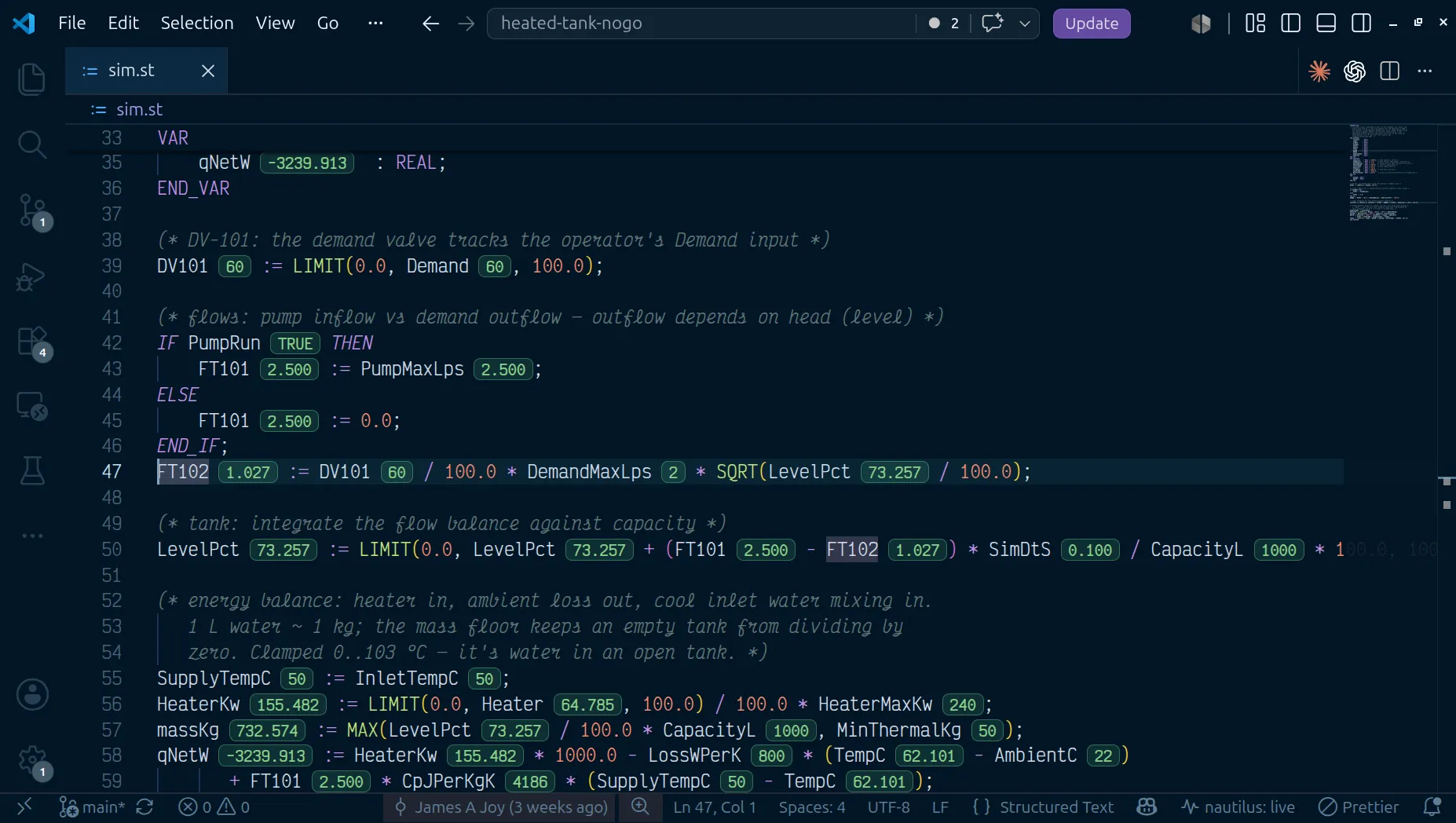
The VS Code extension highlights .st with no setup, from keyword lists
generated out of the compiler. With the CLI installed it also runs
nautilus lsp, the same compiler over stdio: diagnostics as you type for parse
and type errors, go-to-definition from an identifier to its declaration, hover
showing the declared type and var section, and completion over in-scope
variables, keywords, types, and the builtin registries.
Point nautilus.runtimeUrl at a running controller and the extension renders
live tag values inline beside every identifier, with a Live Values panel and a
Set Live Value command. The program commands work on .st directly:
Download Program to Controller, Diff Program with Controller, Rollback
Controller Program, and Pull Program from Controller.
Tooling
Section titled “Tooling”nautilus check # compile every .st, .fbd, .ld, .sfc under the pathnautilus test # *_test.yaml acceptance tests, on a virtual clocknautilus pull --host c1 # write a controller's running source back to the filenautilus check prints gcc-style file:line:col: message diagnostics and exits
non-zero when it finds any, which is what CI gates on. Tests are YAML fixtures
asserting on tags over virtual time; see Testing.
Downloading a program warm-swaps it into a running controller with state carried
across, a failed compile leaves the running program untouched, and nautilus pull --check fails a build when a controller holds edits nobody pulled back.
Online edits has the whole loop.
Not supported
Section titled “Not supported”- Pointers and references. No
REF_TO, no dereference operator. VAR_ACCESS,CONFIGURATION,RESOURCE, andTASKdeclarations. Tasks come fromnautilus.yamlor the Go composition.- Enumerated and subrange types.
TYPEdeclares aSTRUCTor an alias. - Date and time-of-day.
DATE,TOD,TIME_OF_DAY,DT, andDATE_AND_TIMEare rejected as unknown scalar types, and their literals do not evaluate. Durations are fine. - Exponentiation with
**. UseEXPT(base, exp)instead. - Length-qualified strings.
STRING[80]is a parse error;STRINGholds any length. - Aggregate initializers.
:= [1, 2, 3]in a declaration is a parse error; assign the elements in the body. VAR_TEMP. It parses as an ordinary local, kept between scans rather than cleared per invocation.CONSTANTenforcement.VAR CONSTANTdeclares and initializes; assigning to one is not an error.
See also
Section titled “See also”- Language reference — types, operators, and every built-in.
- Function blocks, libraries, and tasks
- The tag model
- Online edits
- Testing
- Ladder (LD), Function Block Diagram (FBD), Sequential Function Chart (SFC)