

Function Block Diagram (FBD)
An FBD program is a text file. .fbd source is a netlist of named wires
driven by blocks, coils that write variables, and function-block instances,
all inside an otherwise ordinary ST POU. The VS Code extension projects that
netlist into the diagram a controls engineer expects, and an edit made on the
diagram is written back into that same file as text. Values flow left to right
through blocks, which is what makes FBD fit continuous control: PI loops,
filters and scaling, selection and limiting, signal conditioning in stages.
When to use it
Section titled “When to use it”Reach for FBD when the logic is mostly analog. A temperature loop with an anti-windup clamp, a rate-of-change calculation, a rolling average, a setpoint selector: these read as a chain of blocks, and the diagram shows the chain.
Interlock logic that is almost entirely contacts and coils reads better as
ladder. A step sequence with holds and aborts belongs
in SFC. Anything needing branching, loops, or CASE is
Structured Text work; the netlist has no
control flow. Tasks can mix languages, one program file each, so a project
usually uses more than one.
A netlist, line by line
Section titled “A netlist, line by line”This is examples/heated-tank-nogo/program.fbd, complete:
PROGRAM Main(* Heated surge tank control, FBD flavor: the pump hysteresis is a seal-in   latch, the temperature PI feeds its integral back through a retained   variable, and a TON delays the low-temperature alarm.   Open the diagram: right-click -> "Open With -> FBD Diagram". *)VAR_EXTERNAL    LevelPct       : REAL;    TempC          : REAL;    ScanDtS        : REAL;    TempSP         : REAL;    TempSPEco      : REAL;    EcoMode        : BOOL;    Kp             : REAL;    Ki             : REAL;    PumpStartLevel : REAL;    PumpStopLevel  : REAL;    PumpRun        : BOOL;    Heater         : REAL;    TempLowAlm     : BOOL;END_VARVAR    integral : REAL;END_VARFBD  // P-101 pump: level hysteresis as a seal-in latch — start when low,  // seal through PumpRun, drop out when high.  low  = LE(LevelPct, PumpStartLevel)  high = GE(LevelPct, PumpStopLevel)  PumpRun := AND(OR(low, PumpRun), NOT high)
  // Eco mode selects the working setpoint (SEL: FALSE takes IN0).  spNow = SEL(EcoMode, TempSP, TempSPEco)
  // TIC-101: temperature PI with anti-windup clamp; integral is retained  // state fed back from its own coil.  e = SUB(spNow, TempC)  integral := LIMIT(0.0, ADD(integral, MUL(Ki, e, ScanDtS)), 30.0)  Heater := LIMIT(0.0, ADD(MUL(Kp, e), integral), 100.0)
  // TAL-101: low-temperature alarm with a 10 s on-delay.  cold = LT(TempC, 62.0)  a1 : TON(IN := cold, PT := T#10S)  TempLowAlm := a1.QEND_FBDEND_PROGRAM
Everything before FBD and after END_FBD is plain ST: the POU header and
its VAR sections, compiled by the same front end as a .st file. The body
accepts these forms.
| Element | Written as | What it is |
|---|---|---|
| Wire | low = LE(LevelPct, PumpStartLevel) | a named block output, defined once |
| Coil | Heater := LIMIT(...) | writes a variable; the target may be an array element or struct member, as in TempHist[1] := TempC |
| FB instance | a1 : TON(IN := cold, PT := T#10S) | declares the instance and calls it in one statement; a1 : TON alone declares it, a1(IN := ...) calls it later |
| Pin read | a1.Q | an output pin of an FB instance |
| Output binding | ET => Elapsed | IEC’s formal-call output form, for capturing a non-BOOL pin such as ET or CV into a variable |
| Negation | NOT high | inline pin negation, drawn as the IEC circle on the pin |
| Constant | 62.0, T#10S, TRUE, 'ok' | a literal input chip |
| Accessor | TempHist[2], M.Speed | array element or struct member, as an input or a coil target |
Full-line // comments inside the body render as notes on the diagram.
Statements may end with ; or just a newline.
How a diagram evaluates
Section titled “How a diagram evaluates”Compilation transpiles the netlist to equivalent ST and runs it through the
ST front end, so FBD inherits the whole type system, the standard library,
and the diagnostics. Errors map back to the exact .fbd line.
Wires are pure combinational expressions. A wire is inlined at every place it is read, so fan-out duplicates an expression rather than creating shared state, and wires must be acyclic: a wire that reads itself, directly or through another wire, is a compile error (“combinational loop through wire”).
Variables carry state. That is where feedback lives. PumpRun := AND(OR(low, PumpRun), NOT high) reads the same variable the coil writes, which is a
seal-in latch and evaluates exactly as a PLC evaluates one. The same
mechanism retains the PI integral across scans, and gives reports.fbd its
four-element shift register: a variable read early in the body carries the
value its coil wrote on the previous scan.
Statements evaluate in source order, with one adjustment: a function-block
call is emitted ahead of any statement that reads its output pins, so a1.Q
reads this scan’s result no matter where a1 sits in the file. Ties keep
source order. There is no other reordering and no way to override it.
Types, functions, and blocks
Section titled “Types, functions, and blocks”FBD uses the same vocabulary as Structured Text. AND, OR, XOR, ADD
and MUL take two or more inputs (the + pin in the editor adds one);
SUB, DIV, MOD and the comparisons take exactly two; MOVE is a
one-input pass-through for wiring. Standard functions such as LIMIT, SEL,
SQRT and CONCAT are written as blocks with positional inputs, and
standard function blocks such as TON, CTU and R_TRIG are instantiated
with named pins. User-defined TYPE structs work as inputs and coil targets.
The whole list is in the language reference.
A FUNCTION_BLOCK you write yourself instantiates the same way a TON does:
r1 : RateOfChange(IN := TempC, DT := RepDtS) TempRate := r1.OUTRateOfChange is authored in an ST library file (blocks.st) and composed
ahead of the program. A FUNCTION_BLOCK can carry an FBD body as well: a
.fbd file with no PROGRAM is a project library, and its blocks
instantiate from any language. Write a block once, call it from whichever
language fits the logic. See function blocks, libraries, and
tasks.
In the editor
Section titled “In the editor”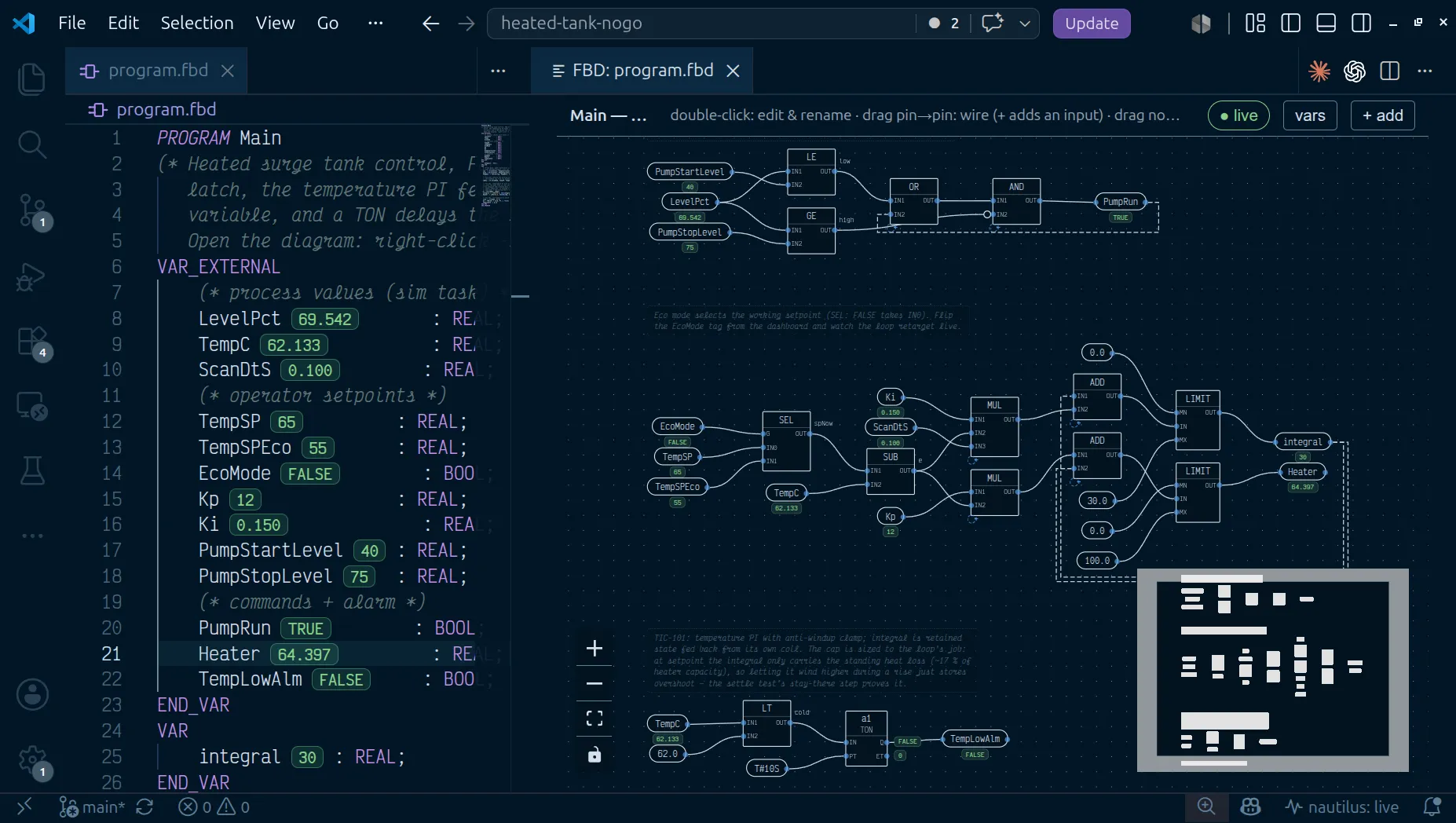
Right-click a .fbd file and choose Open With → FBD Diagram to use the
diagram as the editor itself, or run nautilus: Open FBD Diagram Preview
to open it beside the text, which then updates as you type.
Structural gestures are resolved by the Go compiler into minimal text edits
against the file: double-click a constant to retype it or a block to rename
it, click an input pin to toggle NOT, drag an output onto a pin to rewire,
delete a selected node, and insert statements from the + add palette
(block-to-wire, coil, timer, counter, comment, bare reference chips, and
variable declarations). Layout is computed from topology by default. Drag a
node to pin it and the position is stored in a (* @layout *) comment that
the compiler skips; auto layout clears every pin.
The vars button opens a panel listing every header declaration, wired or
not, with its section, its live value, an unused marker when nothing in the
logic references it, and an amber no tag badge on a VAR_EXTERNAL with
no matching tag on the controller. A read of a tag that was never written
faults the scan, so clear that badge before you download.
With a controller reachable, live values paint onto the diagram: value pills on variable chips and on FB output pins, alongside the inline values in the text editor.
nautilus: Diff FBD Diagram (vs git HEAD) overlays the committed and
working-tree diagrams, coloring added, removed and changed blocks and wires.
(vs Controller) compares against the program a live controller is running.
Tooling
Section titled “Tooling”nautilus check # compile .fbd (and .st/.ld/.sfc); the CI gatenautilus test # acceptance tests, virtual clocknautilus fbd graph f.fbd # the diagram render model as JSONnautilus fbd edit # apply one structural edit op; stdin/stdout JSONA controller running an FBD program serves and accepts the .fbd text
itself, so download, text diff, nautilus pull and the sync status bar work
as they do for .st. A warm swap migrates retained state by name and type,
so a PI integral or a running TON keeps its value through the edit; see
online edits. An edit routes to a task by PROGRAM name,
so reports.fbd downloads without disturbing Main.
Because the source is text, a wiring change reviews as a diff:
cold = LT(TempC, 62.0)cold = LT(TempC, 55.0)Not supported
Section titled “Not supported”- Authoring a
FUNCTIONin FBD. Functions are ST; blocks may be FBD or ladder. EN/ENOpins. Blocks always evaluate.- Execution-order overrides. Order is source order plus the FB-before-reader rule described above.
- Control flow: no
IF,CASE, or loops in the netlist. - Inline arithmetic in an array index. Compute the index on a named wire
first, then use
Levels[i]. - Defining the same wire twice, or a wire that feeds itself. Both are compile errors.
See also
Section titled “See also”- Language reference — evaluation semantics and every built-in operator, function, and function block.
- Function blocks, libraries, and tasks
- The tag model
- Online edits
- Testing
- Structured Text, Ladder, Sequential Function Chart